
Why Data Privacy and Cloud Security are the True Bedrocks of Global Medical Affairs
As Medical Affairs transitions to an omnichannel, AI-accelerated strategic engine, pharmaceutical companies face a new challenge: connecting rapid scientific exchange with uncompromised data privacy and sovereign cloud governance.
The rapid digitalization of life sciences has created an unprecedented challenge for pharmaceutical companies: How do you turn high-velocity medical communication into compliant, audit-ready, and legally sovereign stakeholder engagement?
The global biopharma race has demonstrated the immense power of digital omnichannel platforms. Healthcare professionals (HCPs), clinical investigators, and Key Opinion Leaders (KOLs) are seeking scientific information online, consulting with Medical Science Liaisons (MSLs), and requesting real-time insights regarding off-label clinical research, real-world evidence (RWE), patient assistance, safety profiles, and molecular biomarkers.
But answering clinical demand is only one part of the equation. The real challenge begins when scientific dialogue moves from initial inquiry to evidence synthesis, medical director approval, cross-border transmission, and long-term regulatory archiving. At each stage, critical questions emerge. Those questions can involve different stakeholders, channels, and business processes across the pharmaceutical organization.
Global Medical Affairs Has Created an Unprecedented Information Demand
Medical Affairs has moved rapidly from being primarily a supportive scientific communications desk to becoming a major strategic driver across clinical development, launch readiness, and commercialization. As utilization of digital scientific channels expands, so does the breadth and complexity of information consumers, patients, and Healthcare Professionals need.
Medical science liaisons frequently address questions about how novel therapies work, biomarker eligibility, potential adverse reactions, expected clinical trial endpoints, dosing in renal impairment, and real-world comparative efficacy.
These questions do not stop when a prescription is written or a clinical trial concludes. Patients and investigators need ongoing information about formulation stability, administration nuances, drug-drug interactions, and pharmacovigilance reporting. HCPs have increasingly complex scientific and medical questions of their own.
At the same time, cyber threats and regulatory penalties have reached all-time highs. The latest IBM Cost of a Data Breach Report revealed that pharmaceutical and healthcare organizations suffer an average breach cost of $10.93 million per incident- the highest of any industry globally for over 13 consecutive years.
Cross-border data regulations are also tightening. Under EU GDPR Chapter V following Schrems II, transferring identifiable European health data or physician records to non-sovereign US servers is prohibited. In China, the Personal Information Protection Law (PIPL) mandates strict local data residency, while FDA 21 CFR Part 11 requires immutable audit trails for every electronic interaction.

The result is a scientific exchange journey that involves more stakeholders, more questions, more data exchanges, and more regulatory checkpoints than traditional engagement models were ever designed to handle.
In other words, providing an answer to a doctor does not simply mean sending an email. It means ensuring that protected health information (PHI) is redacted, the scientific source is validated, cross-border residency laws are honored, and an immutable 21 CFR Part 11 audit log is permanently preserved.
The Scientific Engagement Journey Is Becoming More Complex
For a modern biopharmaceutical organization, the stakeholder journey involves five distinct stages of data interaction:
| 1. Awareness & Outreach | 2. Scientific Inquiry |
3. Triage & Redaction |
4. Evidence Synthesis |
5. Compliance & Archiving |
|---|---|---|---|---|
| Medical education Congress symposia Disease state portals Publication releases |
HCP consultation Unsolicited requests Off-label questions MSL discussions |
Automated PII scrub Adverse event clock Sovereign geofence Jurisdiction check |
Clinical study reports Grounded RAG search Response drafting Medical approval |
Part 11 WORM logs Audit trails recorded CMEK encryption Inspection readiness |
Each stage generates sensitive data exchanges. A patient may need to know where to find approved clinical trial protocols. An HCP may require a detailed response package on an unpublished biomarker correlation. An MSL may need to document an exchange with an investigator. A Medical Information team may receive an inquiry requiring a documented, evidence-based response with pharmacovigilance screening.
Historically, these interactions have been managed through disconnected silos. Commercial marketing generated brand awareness. HCPs provided clinical care. Patient-support programs handled co-pay assistance. Medical Affairs managed scientific exchange. Medical Information answered phone inquiries on legacy on-premise databases.
But the healthcare professional experiences this as one enterprise. The technology supporting these interactions should therefore be designed to support a unified, cloud-secure, and legally sovereign model.
Digital Scientific Exchange Creates a New Role for Medical Information
Medical communications are strictly regulated. Pharmaceutical companies must provide fair, balanced, and non-promotional scientific evidence. FDA, EMA, and national regulations mandate clear separation between promotional marketing and unbiased medical inquiry responses.
Instead of viewing Medical Information solely as a reactive back-office cost center, leading life sciences companies position it as a secure strategic foundation of the broader customer-engagement ecosystem.
| Stakeholder / Channel Compliance & Security Role | |
|---|---|
| Omnichannel Engagement |
Provide transparent disease education and compliant self-service access |
| Digital Medical Portals | Deliver authenticated, self-service scientific information with automatic PII masking |
| HCP / MSL Interaction | Facilitate peer-to-peer scientific exchange under mutual TLS 1.3 encryption |
| Medical Information Core | Provide a GxP-validated mechanism for responding to complex unsolicited inquiries with 21 CFR Part 11 electronic audit trails |
SCIMAX MI: Connecting Questions to Medical Information
SciMax Global designed SCIMAX MI specifically for Medical Information and Communication, providing pharmaceutical organizations with a centralized, sovereign cloud platform for managing inquiries and delivering consistent, evidence-based responses.
For global life sciences enterprises, this becomes particularly vital as inquiry volumes surge:
- HCP product-information inquiries & unsolicited requests
- Medical Information intake, triage, and multi-country routing
- MSL-supported scientific exchange workflows with mobile encryption
- Real-time edge de-identification scrubbing all 18 HIPAA PHI identifiers
- Adverse event and product quality triage with automated 24-72 hrs clock escalation
- Response package development, scientific grounding, and medical approval
- Standard and customized evidence packages grounded in clinical study reports
- Inquiry tracking, audit trail logging, and regulatory inspection metrics
- Integration with other third-party enterprise clinical & CRM systems
- Agentic AI-enabled Medical Information workflows through SCIMAX ARIN
The objective is not simply to answer more questions. It is to help organizations answer the right questions, through the right channel, with the right information, while maintaining appropriate compliance and sovereign governance.
SCIMAX CP: Extending Engagement Beyond the Traditional Call Center
While SCIMAX MI provides the core Medical Information foundation, SCIMAX CP-the SCIMAX Collaborative Portal-extends the engagement model into a secure, sovereign digital online environment. This provides an
additional channel through which HCPs, clinical investigators, MSLs, and authorized stakeholders can interact with a pharmaceutical organization.
Instead of requiring every interaction to begin with an unencrypted email or telephone call, a digital portal supports appropriate self-service experiences while providing an automated path to escalation when a complex question requires specialized medical director review.
For global medical affairs, this is indispensable. An oncologist preparing for a morning clinic can access verified clinical dosing guidelines. An MSL can securely capture an off-label inquiry without scribbling notes on unsecured paper. An inquiry that cannot be addressed through self-service is automatically routed into the sovereign Medical Information workflow.
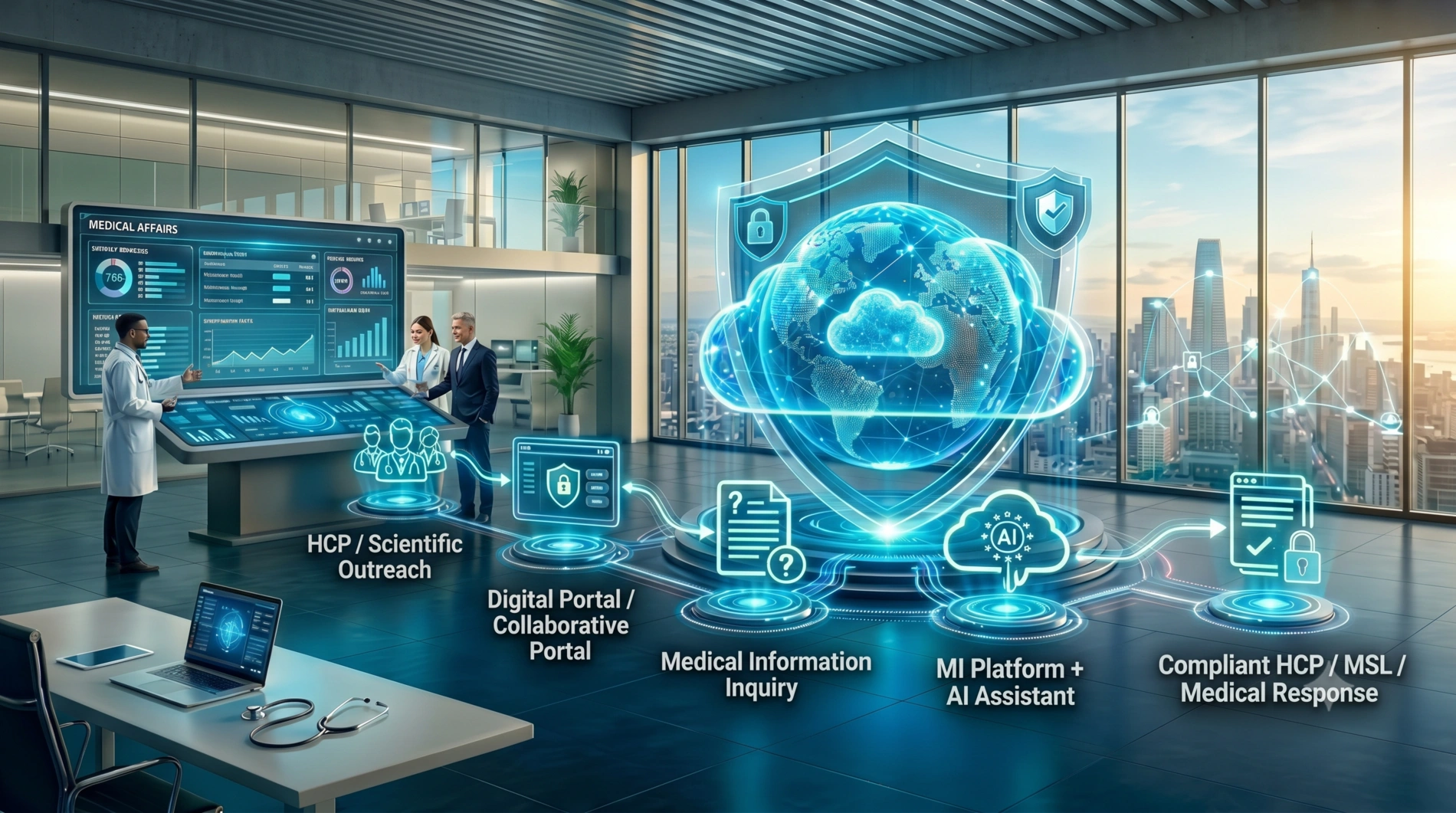
Important distinction: This does not mean turning Medical Information into a promotional channel. Rather, it means creating robust infrastructure for the appropriate separation and sovereign connection of educational, scientific-exchange, and medical-information activities.
Moving from Customer Touchpoints to a Connected Journey
The modern biopharma landscape illustrates a broader transformation taking place across life sciences. Companies can no longer think about engagement solely in terms of individual regional channels.
The challenge for pharma is to provide an experience in which the appropriate organizational function can respond without forcing the clinician to navigate internal organizational silos or worrying whether their data is legally protected.
This is where purpose-built applications such as SCIMAX MI, SCIMAX ARIN, and SCIMAX CP play a significant role.
The Opportunity and Challenge for Biopharmaceutical Leaders
The rapid global expansion of pipeline assets and scientific data is creating an equally significant operational and compliance challenge:
- Inquiry volumes from HCPs, investigators, and clinics are surging worldwide.
- MSLs need instantaneous, mobile access to confidential pre-publication evidence.
- Cross-border transfer restrictions (GDPR Schrems II, China PIPL) prohibit centralized data pooling.
- Legacy unencrypted spreadsheets and email communications create catastrophic breach liabilities.
- As digital engagement scales, life sciences companies must provide accurate, compliant, and sovereign information throughout the entire product lifecycle.
The next generation of pharmaceutical engagement cannot be limited to deploying more disconnected SaaS tools or adding more channels. It requires connecting those channels with the underlying secure processes that support them.
| SCIMAX CP | Digital engagement and self-service environment for HCPs, clinical investigators, MSLs, and authorized stakeholders. |
|---|---|
| SCIMAX MI | Purpose-built sovereign Medical Information infrastructure needed to manage inquiries, develop compliant responses, and support 21 CFR Part 11 audit trails. |
| SCIMAX ARIN | Purpose-built private AI Agents with Zero Data Retention (ZDR) and deterministic scientific grounding designed to optimize and accelerate medical responses. |
Together, these capabilities help pharmaceutical organizations move beyond a fragmented collection of touchpoints toward a truly connected, sovereign Medical Affairs ecosystem.
Conclusion
The digitalization of Medical Affairs has created unprecedented opportunities for rapid scientific exchange, but generating medical content is only half the battle. Healthcare professionals, investigators, and regulators require seamless access to appropriate, timely, and compliant information throughout the treatment lifecycle-yet most pharmaceutical organizations still operate through fragmented, disconnected cloud channels.
The solution lies in connecting these experiences through sovereign architecture. SciMax Global’s purpose built applications-SCIMAX MI for Medical Information infrastructure, SCIMAX CP for digital self-service engagement, and SCIMAX ARIN for AI-enabled workflows-help pharmaceutical organizations move beyond fragmented touchpoints toward a truly connected, legally fortified Medical Affairs ecosystem.
For biopharmaceutical leadership, this evolution is essential. The question is no longer “How do we answer inquiries faster?” It is: “Are we prepared to protect data privacy and cloud sovereignty across everything that happens next?”
References
- IBM Security & Ponemon Institute. (2025). Cost of a Data Breach Report 2025. (Global healthcare & pharma average: $10.93M). https://www.ibm.com/reports/data-breach
- European Data Protection Board (EDPB). (2020). Recommendations 01/2020 on measures that supplement transfer tools to ensure compliance with the EU level of protection of personal data (Schrems II). https://edpb.europa.eu
- U.S. Food and Drug Administration (FDA). (2023). Part 11, Electronic Records; Electronic Signatures – Scope and Application; Guidance for Industry. Part 11, Electronic Records; Electronic Signatures – Scope and Application | FDA
- Standing Committee of the National People’s Congress. (2021). Personal Information Protection Law of the People’s Republic of China (PIPL). http://www.npc.gov.cn
- International Society for Pharmaceutical Engineering (ISPE). (2022). GAMP 5: A Risk-Based Approach to Compliant GxP Computerized Systems (Second Edition). https://ispe.org
About the author

Sandhya Kushwaha
MarCom & Operations Specialist,
SciMax Global
Sandhya is a Marketing Communications & Operations Specialist at SciMax Global, where she supports content strategy, marketing operations, and cross-functional initiatives across the life sciences industry. She specializes in translating complex healthcare and technology topics into engaging content, while driving campaign execution, performance analysis, and stakeholder collaboration.

