
Agentic AI Success Beyond Tech
Introduction
Across life sciences companies including pharmaceutical, biotechnology, medical device organizations, and CROs, agentic AI has become a headline topic. Technology Vendors are beginning to highlight and demonstrate autonomous agents capable of classifying cases, drafting responses, and orchestrating workflows within medical information systems.
The technology is impressive.
Yet in conversations with life science company partners, a consistent theme keeps emerging: the biggest challenge is no longer whether AI can work, it is whether organizations are ready to implement it responsibly and effectively.
From a product leadership standpoint, this distinction is critical. Agentic AI is not just another feature release. In regulated medical affairs environments, it represents a fundamental shift in operating models, governance, and collaboration.
The Opportunity Is Clear but So Are the Pitfalls.
Medical information teams face growing complexity around increasing volumes of inquiries, heightened regulatory expectations, global operations, and pressure to deliver faster, insight-driven scientific engagement.
Agentic AI promises to help by
- Autonomously triaging inbound requests
- Recommending scientifically grounded draft responses
- Suggesting approved content and publications
- Flagging safety and quality relevant signals
However, many programs stall after pilots. Not because the AI underperforms but because the implementation strategy focuses on technology procurement rather than organizational transformation. This blog outlines key challenges and proven steps to succeed.
Why Most Implementations Struggle
Tool-Led Instead of Outcome-Led
Organizations often begin with vendor evaluations rather than business priorities. The conversation quickly becomes about models, integrations, and architecture.
What gets lost is the more important discussion on
Without that clarity, agentic AI becomes an isolated experiment rather than an operational capability.
Automating Before Simplifying
Another common misstep is layering AI on top of legacy processes. Without aligning processes and expectations, new technology simply accelerates old inefficiencies. If case intake is fragmented, approvals are inconsistent across regions, or content governance is unclear, autonomous agents will not resolve those issues, they will scale them.
New technology only delivers value when processes and expectations evolve with it. High-impact programs first redesign their future-state workflows and then determine where agentic behavior genuinely adds value.
Treating Governance as an Afterthought
In medical affairs, compliance is not optional. Audit trails, version control, traceability, and documented human review are core requirements. Too often, governance frameworks are developed late in the project lifecycle, slowing deployment and grinding down stakeholder confidence.
Leading organizations take the opposite approach where they design governance into the product from day one, embedding approval routing, explainability, monitoring, and escalation paths directly into AI-enabled workflows.
Underestimating Change Management
The most sophisticated AI system will fail if teams do not adopt it with a clear understanding of its potential and limitations. Medical reviewers, safety scientists, and field teams must understand how agents work, where their responsibilities begin and end, and how to intervene when needed. Programs that succeed invest heavily in training, phased rollouts, and feedback-driven iteration.
Agentic AI adoption is as much a people journey as it is a technical one.
What Successful Implementations Do Differently
Across mature programs, a consistent set of principles emerges.
Start With Business Outcomes
Rather than selecting technology first, successful teams define measurable goals like:
- Reduce inquiry intake burden
- Improve global consistency
- Reduce response times for medical inquiries
- Increase reviewer productivity
- Strengthen inspection readiness
These outcomes guide decisions about agent autonomy, controls, and integration.
Design Human-in-the-Loop as the Default
Autonomous does not mean ungoverned. In regulated environments, agents function best as digital colleagues drafting, recommending, and flagging while humans remain accountable for final decisions. Clear hand-offs and escalation paths are fundamental.
Embed Compliance with the Operating Model
Effective programs treat governance as a capability and not a constraint. Audit logs, content lineage, model versioning, performance monitoring, and quality dashboards become part of everyday work and not external controls layered on later.
Build Cross-Functional Ownership
Agentic AI programs succeed when medical, safety, quality, IT, and vendor partners design the solution together. This shared ownership accelerates adoption, improves design quality, and reduces downstream friction.
Product Leadership Perspective
From a product management lens, implementing agentic AI in medical affairs is not an IT deployment. It is a strategic transformation initiative.
It reshapes:
Organizations that treat it accordingly with executive sponsorship, clear operating models, and long-term roadmaps are the ones realizing sustainable value.
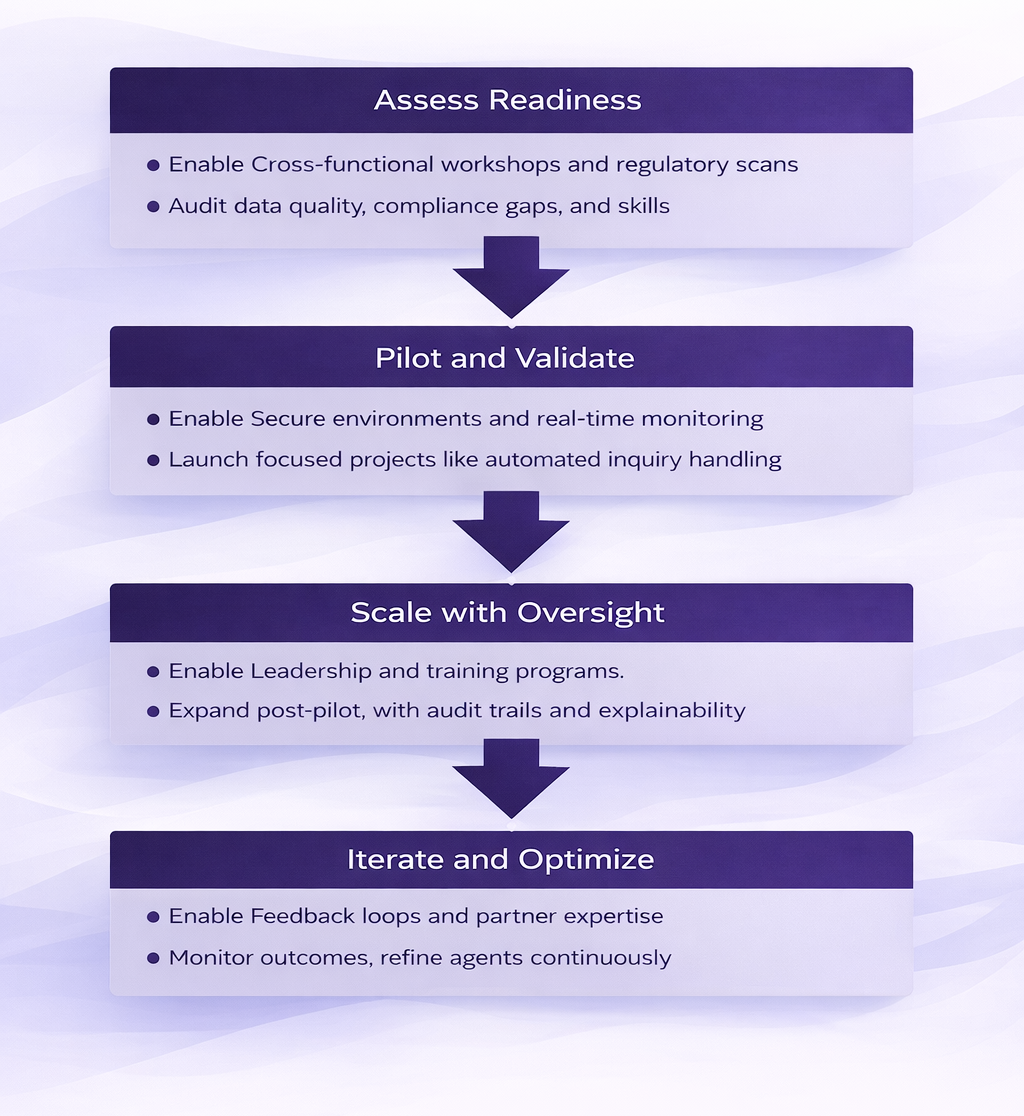
Roadmap to Implementation
What Life Science Companies Should Remember
Agentic AI has reached a level of maturity where the technology itself is rarely the limiting factor, execution is.
The differentiators now lie in:
- disciplined use-case selection
- thoughtful process redesign
- strong governance frameworks
- continuous engagement with end users
- realistic change programs
When these elements come together, agentic AI become more than an innovative project, it becomes a core capability of modern medical affairs. Choose vendors like SciMax Global who can support you in transforming your business operations with technology.
Closing Thought
The organizations that will lead in AI-enabled medical affairs are not those that deploy the fastest models. They are the ones that invest the most in designing how humans and agents work together.
Technology opens the door to transformation, but process, governance, and people are what truly bring it to life.

